
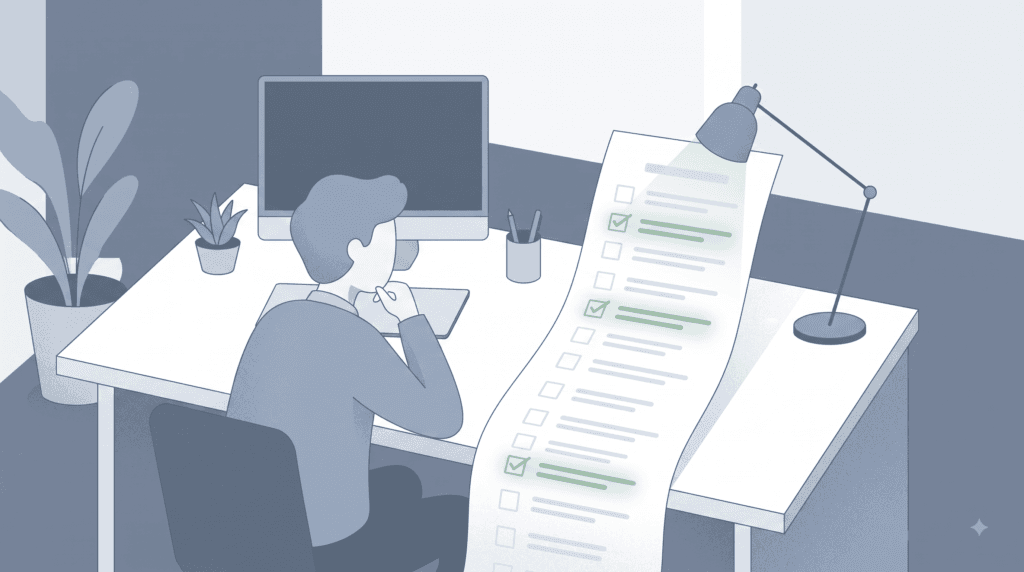
Twenty years in, my to-do list still grows faster than I can clear it. That never stops. What changed is that I stopped trying to clear it. Some days I close out four things, some days I close out zero, and the project still moves forward, because I’ve narrowed it down to three things I do without fail, before anything else gets my attention. Everything else is negotiable. These three aren’t.
I didn’t arrive at this list by reading it somewhere. I arrived at it by watching what actually broke projects, mine and other people’s, and working backward to the daily habit that would have caught it early.
1. Go look at the real status yourself
Status meetings tell you what people are willing to say out loud in front of the group. That’s not the same thing as what’s actually happening. Every single day, before I trust a single status update, I go look at the source myself: the board, the ticket queue, the commit history, whatever the ground truth is for that particular team. It takes ten minutes and it catches things that never make it into a standup.
I learned this the hard way early on, trusting a green status for weeks because that’s what got reported, then finding out the actual work had stalled two weeks earlier and nobody wanted to be the one to say it out loud in front of the group. Now I check first and ask questions second. It changes the whole tone of the conversation, because you’re not catching someone in a lie, you’re already halfway to solving the actual problem before the meeting starts.
2. Find the relationship most at risk and touch it on purpose
Every project has one relationship that’s currently the most fragile, whether that’s two team leads who disagree on approach, a stakeholder who’s gone quiet, or a vendor who missed their last two commitments. It changes week to week, sometimes day to day. Part of my daily routine is asking myself, honestly, which relationship is closest to breaking right now, and then doing one small thing about it before the day ends. A short message. A five-minute call. Just enough to keep the thread from snapping.
Most project failures I’ve seen didn’t start as technical problems. They started as a relationship nobody tended to until it was too damaged to repair quickly. You can’t fix all of them every day. You can make sure the most urgent one doesn’t get ignored.
3. Close yesterday’s loose threads before opening new ones
This is the one I break most often, and the one that costs me the most when I do. It’s tempting to start the day with whatever’s newest and loudest. But open loops from yesterday, the email you meant to send, the decision you were supposed to confirm, the follow-up you promised someone, don’t disappear just because today showed up. They pile up quietly until you’re carrying twenty half-finished threads and forgetting which ones matter.
So before I let anything new take priority, I run through what I left open the day before and close what I can, even if it’s a two-line message that just says “confirming we’re good on this.” It’s a small discipline, but it’s the difference between a project that feels chaotic and one that just feels busy.
What this looks like on a bad day
Some days none of the big stuff happens. The plan doesn’t get updated, the retro doesn’t get held, the fancy dashboard doesn’t get touched. That’s fine, as long as these three things still happened: I know what’s actually true, the most fragile relationship got a little attention, and yesterday didn’t quietly become a pile of unfinished business. Everything else can wait a day. These three can’t, because they’re not tasks, they’re what keeps you from losing track of the project entirely.
Why three, and not a longer list
Early in my career I had a much longer list. Update the plan, review the risk log, check every channel, prep every deck, touch base with every work stream lead, and on and on until the list itself became the thing I was managing instead of the project. Being busy actually stopped meaning useful, a long time before I noticed it had.
Cutting the list down to three wasn’t about doing less. It was about being honest that most of what felt urgent on any given day was really just noise dressed up as importance. The plan document can be a day behind. The dashboard can go untouched for an afternoon. But if you don’t know what’s actually true, if the most fragile relationship on the project snaps because nobody was paying attention, or if yesterday’s loose threads have quietly turned into ten of them, no amount of dashboard polish saves you from that.
Three is also small enough that I can actually hold myself to it, even on the days that fall apart by ten in the morning. A list of fifteen priorities isn’t a list of priorities anymore, it’s just a list. Three things I genuinely will not skip forces an honest conversation with myself about what actually matters versus what just feels productive.
Building the habit
If you want to try this, don’t overthink your own three. Watch your own projects for a couple of weeks first. Notice what almost went wrong, and trace it back. Usually it’s one of these three roots: you believed a status that wasn’t true, a relationship went unattended until it broke, or small loose ends piled up until they became one big mess. Your specific three might look a little different from mine depending on what your projects tend to break on, but I’d bet they rhyme with these.
Write them down somewhere you’ll actually see every morning, not buried in a project plan nobody opens. Some PMs I’ve coached put them as a sticky note on their monitor. I keep mine as the first three lines in my daily notes doc, before anything else gets written. The exact method doesn’t matter. What matters is that on your worst day, the day everything else falls off the rails, these three still happen.
If you’re drowning in your own to-do list right now, try this for a week. Don’t add anything new to your daily routine, take almost everything else away and keep only these three. See what happens to how the week actually feels.
What’s the one thing you never skip, no matter how bad the day gets? I’d like to know what’s on your list.