
For most of my early career I thought the job was mostly logistics. Sequence the work, track the dependencies, report the status, repeat. It took years of watching technically well-run projects quietly fail anyway before I understood that the logistics were never really the hard part. The hard part was always the people, and specifically, whether I could read what was actually going on with them underneath what they were saying out loud.
I don’t think of emotional intelligence as a soft skill that sits next to real project management skills. At this point, I think of it as the operating system the rest of the job runs on. You can have a perfect schedule and still lose a project because a key person felt unheard, checked out quietly, and nobody noticed until the work started slipping.
The status update that isn’t really the status
A developer says a task is “basically done” in a tone that doesn’t quite match the words. A stakeholder agrees to a plan a little too quickly, without the pushback you’d expect given how much they usually push back. Someone who’s normally vocal has gone unusually quiet in the last two meetings. None of that shows up in a status report, and all of it is data if you’re paying attention.
Emotional intelligence in this job starts with noticing the gap between what’s said and how it’s said, and being willing to gently name it instead of taking the words at face value because that’s easier and faster. “You said that’s basically done, but something in how you said it made me want to check, is there a piece you’re still worried about?” That single question has surfaced more real risk for me over the years than any status report template ever has.
Reading the room versus reading the plan
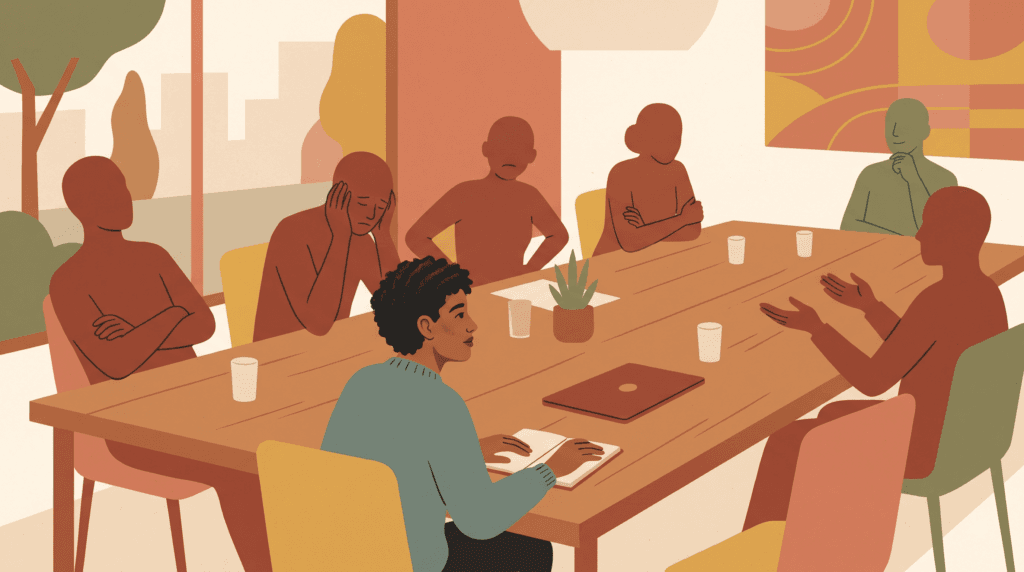
I’ve sat in plenty of meetings where the plan on the screen said one thing and the room said something completely different. Everyone nodded along to a timeline nobody actually believes in. A go-ahead that’s really resignation, not agreement. If you’re only tracking what’s on the plan, you’ll miss the moment the room stopped believing it, and you’ll find out three weeks later when the thing everyone silently doubted turns out to have been right to doubt.
This is a skill you build by watching, not by reading about it. Who talks right after leadership speaks, and who waits until leadership’s out of the room. Whose objections get raised directly and whose get raised as jokes, because a joke is a safe way to say something true without fully committing to having said it. Once you start noticing those patterns, meetings become a much richer source of information than the agenda suggests.
The part that took me the longest to learn
The hardest emotional intelligence skill for me personally wasn’t reading other people, it was managing my own reaction before I responded to them. Early on, if someone pushed back hard on a plan I’d worked hard on, I’d get defensive, even if I didn’t show it obviously, and that defensiveness leaked into how I responded, making the conversation worse instead of better.
What changed things was building in a pause, even just a few seconds, between feeling the reaction and responding to it. Long enough to ask myself whether I was about to defend the plan or actually engage with the concern. Those are very different responses, and the people you work with can tell the difference even when you think you’re hiding it well.
Why this matters more as you get more senior
The higher up you go, the more your job shifts from doing the work yourself to creating the conditions where other people can do their best work. That shift makes emotional intelligence more important, not less, because you’re no longer being evaluated on your own output, you’re being evaluated on whether the team around you is functioning. A brilliant technical plan delivered by a team that doesn’t trust each other or doesn’t trust you will underperform a mediocre plan delivered by a team that does.
I’ve staffed and coached other project managers for a good part of my career, and the ones who grew fastest weren’t always the most technically sharp. They were the ones who could walk into a tense room and lower the temperature instead of raising it, who could tell the difference between someone who needed to be pushed and someone who needed to be heard.
A quick check before you walk into any hard conversation
Before I walk into a conversation I know is going to be tense, a tough conflict, delivering bad news, pushing back on a stakeholder, I run through a short, honest check with myself. What am I actually feeling right now, not what I’m supposed to be feeling. Am I about to protect my own ego or genuinely try to solve the problem in front of me. What does the other person probably need from this conversation, and is that the same thing I’m walking in ready to give them.
It takes thirty seconds and it’s saved me from more than one conversation that would have gone sideways if I’d walked in reacting instead of thinking. It’s a small habit, but it’s the difference between a hard conversation that builds trust and one that quietly damages it, even when the words you use are almost identical either way.
It’s a practice, not a personality trait
The most common thing I hear from newer PMs is some version of “I’m just not naturally good at reading people.” Maybe some people start further along than others, but this is a practiced skill, not a fixed trait. It gets built the same way any other skill does, by noticing when you missed something, being honest with yourself about it, and paying closer attention next time. Nobody starts out great at this. They just get enough reps in noticing what they missed.
What’s the time you caught something in the room that wasn’t in the plan or the status report? What tipped you off? I’d like to hear it.